Nicolas Tricard
I build differentiable simulation frameworks that run at GPU/TPU scale, enabling gradient-based inference of physical fields from sensor data. My work combines neural methods (diffusion models, attention, neural ODEs) with PDE-constrained optimization and high-performance computing (CUDA, JAX, XLA) to solve inverse problems in fluid dynamics, combustion, and materials science.
Research Interests
- Inverse problems & differentiable programming: differentiable rendering (NeRF-style methods), PDE-constrained optimization
- Neural methods for physical systems: neural ODEs, diffusion models, attention mechanisms
- High-performance scientific computing: GPU/TPU-accelerated simulation, scalable differentiable programming
- Uncertainty quantification: Bayesian inference for physics-constrained inverse problems
Technical Skills
- Languages
- Python, C/C++, Julia, MATLAB
- ML Frameworks
- JAX, PyTorch, TensorFlow/XLA
- GPU / HPC
- CUDA, Kokkos, TPU/XLA, MPI, SLURM
- Simulation
- OpenFOAM, LAMMPS, Cantera
- Methods
- Differentiable rendering, neural ODEs, diffusion models, adjoint methods, Bayesian inference
- Tools
- Git, Docker, Linux, LaTeX
Education
Massachusetts Institute of Technology
September 2023 – May 2027University of Connecticut
August 2017 – May 2022B.S. Mechanical Engineering, Minor in Computer Science (Merit Scholar)
Experience
Simulation Researcher – Google Research
August 2024 – December 2024Graduate Researcher – Massachusetts Institute of Technology
September 2023 – May 2027Part-time Researcher – U.S. Naval Research Laboratory
May 2022 – May 2024Graduate Research Assistant – University of Connecticut
June 2020 – August 2023Awards & Fellowships
- GE Vernova Fellowship – Merit-based, full funding, only 8 MIT fellowships awarded annually (2025–2026)
- MathWorks Fellowship – Merit-based offer, full funding, MIT (2025–2026)
- Doug and Sarah Bailey Award – Merit-based fellowship, MIT (2023–2024)
- Nominated Best Paper Presentation Award – ICHMT Conference (2021)
- Cum Laude, Dean's List, Honors Scholar, Academic Excellence Scholarship – UConn (2017–2021)
Selected Projects
-
Differentiable Rendering for Hyperspectral Flame Diagnostics – MIT
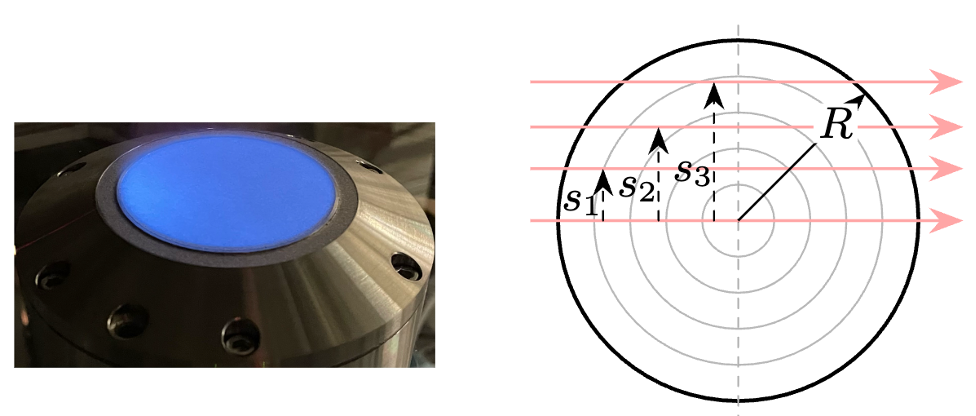
Developed a differentiable rendering (DR) framework for gradient-based reconstruction of 3D thermochemical fields from hyperspectral images. Formulated the inverse problem using GPU-accelerated non-gray radiative transfer and integrated diffusion and attention-based priors for sparse-view reconstruction trained from fluid simulations. Demonstrated improved recovery of chemical species in hydrocarbon, ammonia, and material synthesis reactors.
Differentiable Rendering CUDA JAX Inverse ProblemsRelated: arXiv preprint (2026) · PCI 2025
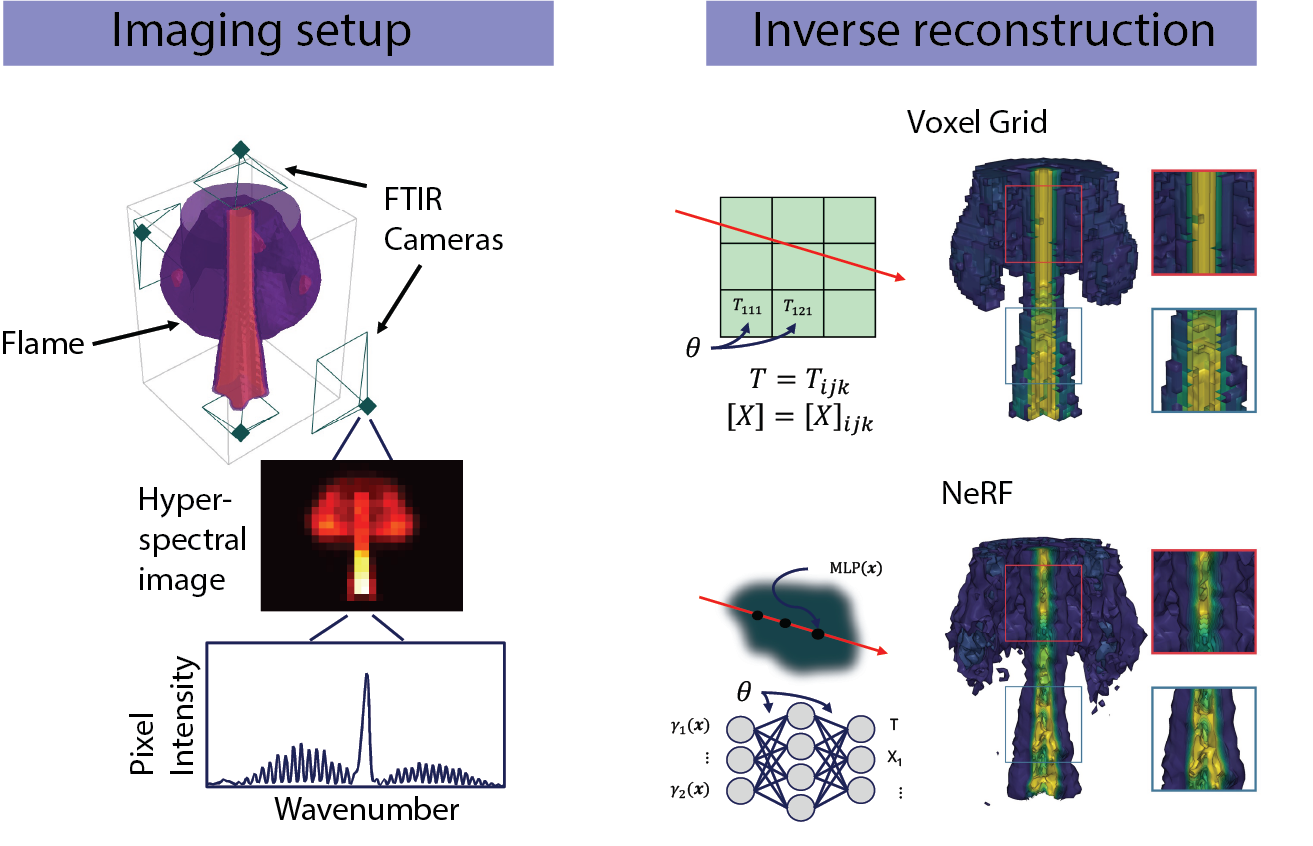
Hyperspectral flame tomography (3-D field reconstruction) 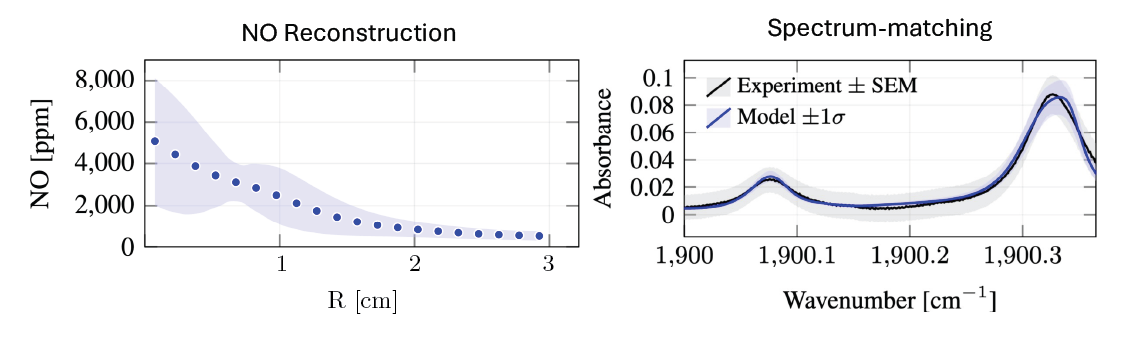
Differentiable spectroscopy / laser absorption inference (McKenna burner example) -
PDE-Constrained Inverse Modeling of Energetic Materials – MIT
Developed an inverse modeling framework to infer material properties and chemical kinetics from experimental burn data. Applied Bayesian inference and reaction-diffusion modeling to enforce physical consistency, with differentiable solvers and adjoint sensitivity analysis for scalable parameter estimation.
Differentiable Physics Adjoint Methods Bayesian Inference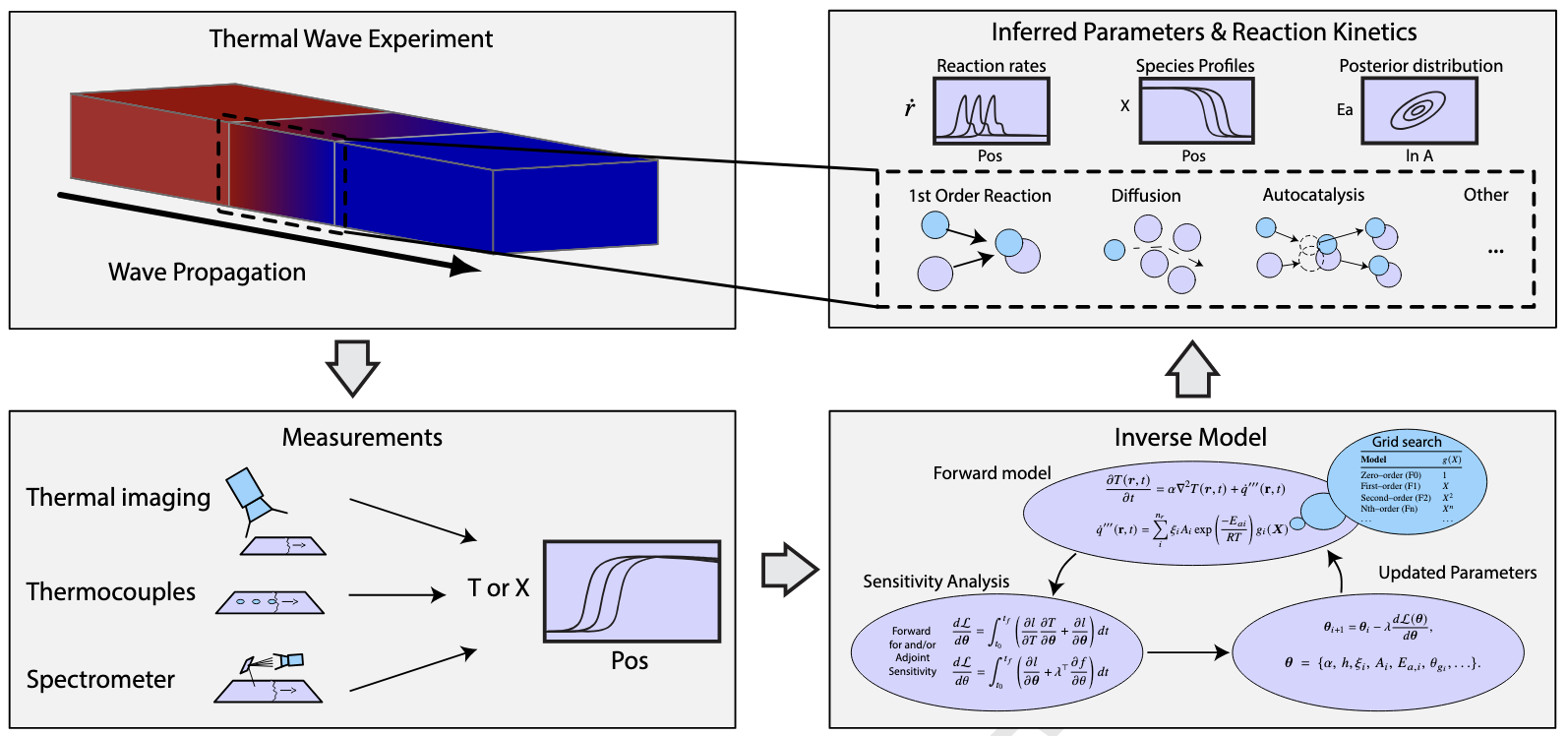
Inverse modeling in thermal wave systems -
Inverse Modeling of CNT Growth via Neural and Physics-Based Methods – MIT
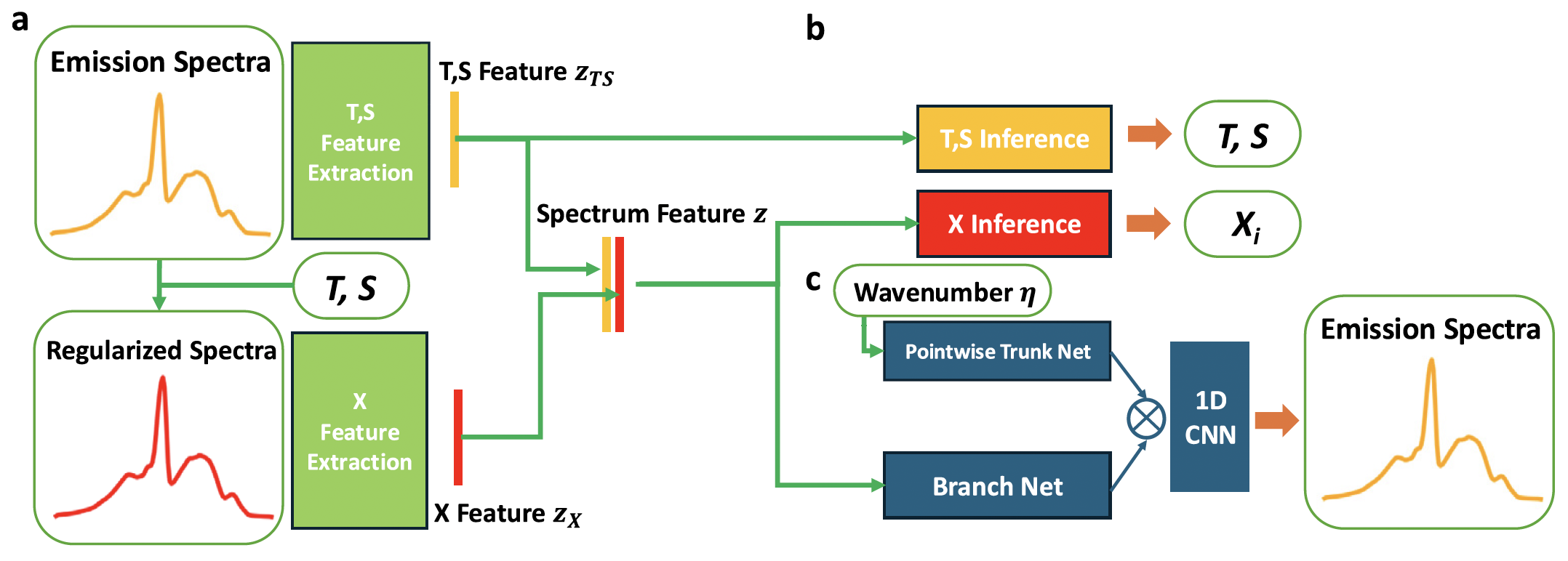
Inferred CNT reactor chemistry from radiation diagnostics for in situ process understanding. Combined ML force fields with active learning to accelerate molecular dynamics simulations of carbon nanotube growth.
Neural ODEs FTIR Diagnostics Carbon Nanotubes Active LearningRelated: Wang et al., Nanoscale, 2025
-
Digital Twin Models of Fluid Dynamic Systems – MIT
Generated a global-local fused attention framework for reconstruction and dynamic forecasting from sparse measurements. Adapted the model to fuse a global latent state with local sensor readouts for rapid, uncertainty-aware prediction. Includes large eddy simulation (LES) of reacting flow over a backward-facing step using OpenFOAM with detailed chemistry.
Attention Digital Twins LES Uncertainty QuantificationRelated: Wang et al., arXiv preprint (2026)
-
Neural ODEs for Stiff Chemical Kinetics – MIT
Developed neural ODE frameworks to learn reaction rate dynamics in large, stiff chemical systems (methane, JP-10, and hydrocarbon mechanisms with hundreds of species). Integrated adjoint-based sensitivity analysis for efficient training and inference.
Neural ODEs Chemical Kinetics Stiff Systems
-
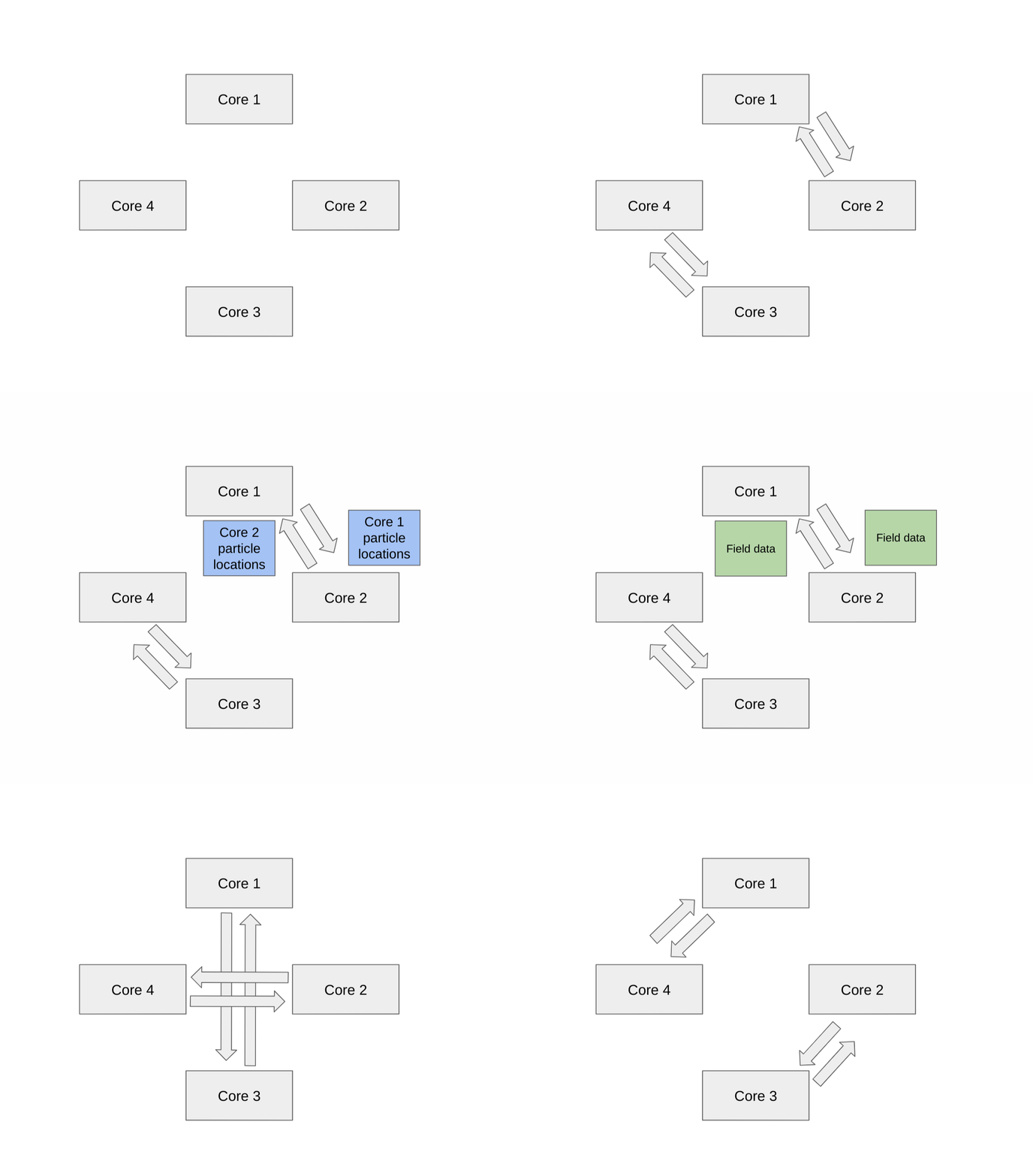
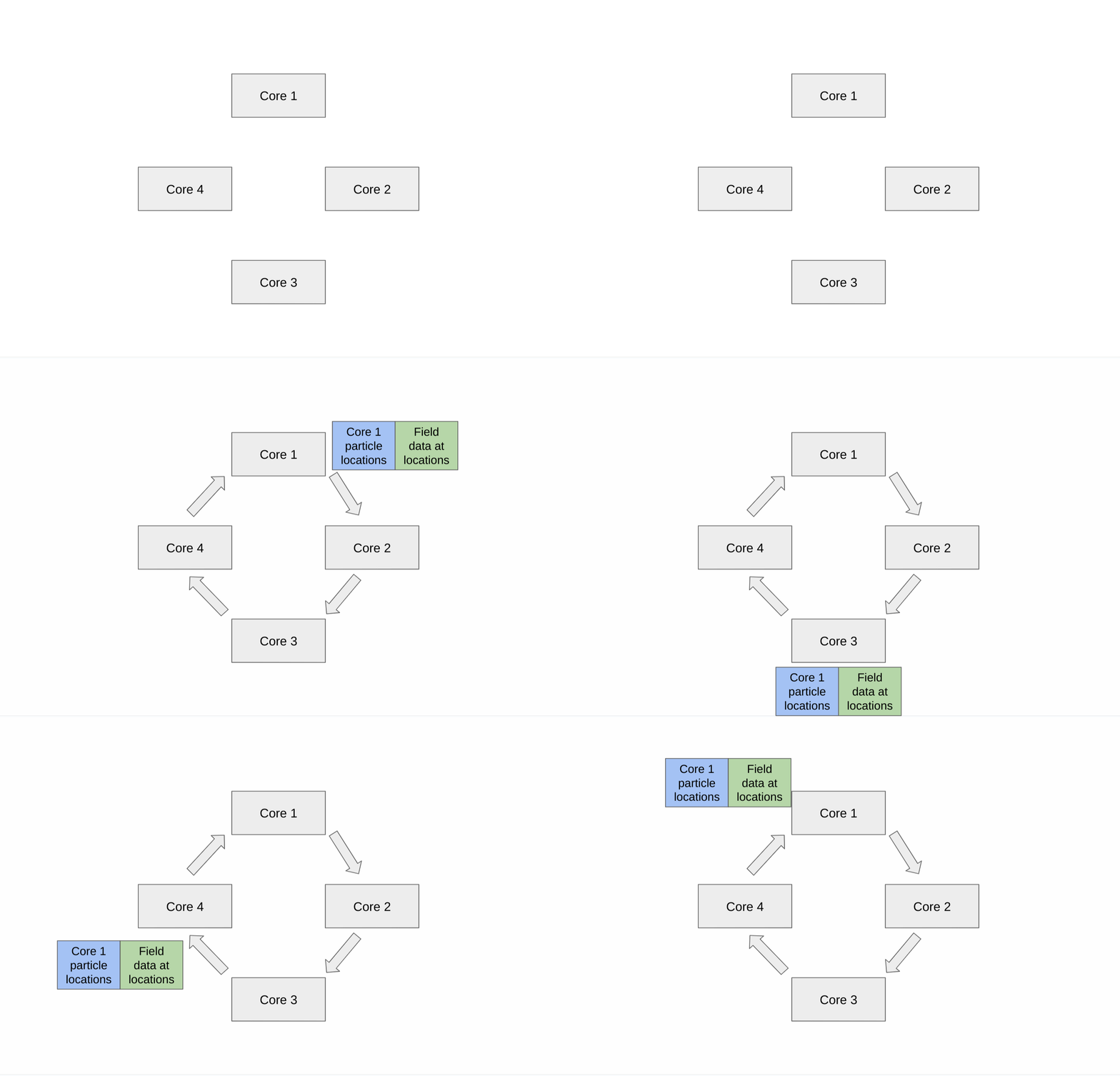
Lagrangian Particle Tracking on TPUs – Google Research
Introduced a multi-TPU particle tracking solver for differentiable wildfire CFD in Swirl-LM. Achieved near-optimal TPU performance by directly analyzing HLO IR, compiler passes, and SPMD sharding. Identified and reported a TensorFlow / XLA compiler bug, contributing to the broader ML ecosystem.
TPU XLA / HLO SPMD Multiphase Flow Wildfire SpottingExternal links: Full Presentation · LPT Module GitHub

256-TPU simulation of particles in cross-flow jet run on Google Cloud. -
CUDA Monte Carlo Ray Tracing for Emitting Media – ORNL / UConn
Led development of a CUDA-based 3D Monte Carlo radiative transfer solver integrated with OpenFOAM. Designed a BVH-based parallelization strategy enabling >400x speedup on Top100 supercomputer GPU clusters. Applied to coupled turbulent CFD simulations in gas turbine systems and high-enthalpy propulsion devices.
CUDA BVH Monte Carlo OpenFOAM Multi-GPU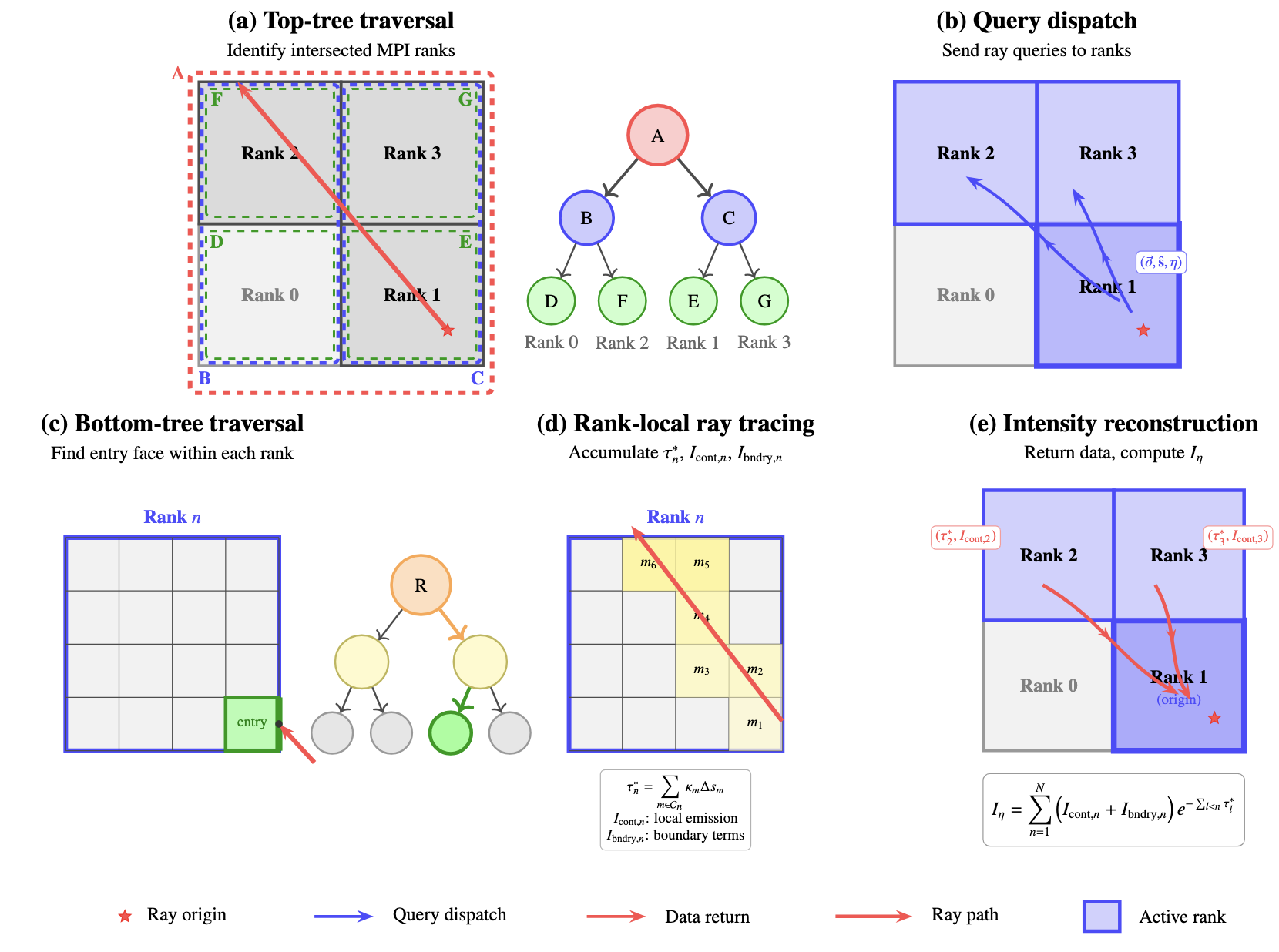
Framework for multi-GPU ray tracing with NVLink and BVH traversal.
-
Thermal-Fluids Modeling & Reacting Flow Simulation – Multi-Institutional
Comprehensive thermal-fluids modeling across combustion and propulsion systems: hypersonic propulsion, gas turbine combustors, spray detonations, and thermal barrier coatings. Work spans GPU-accelerated CFD (Discontinuous Galerkin and finite volume), conjugate heat transfer with participating media radiation, and reduced-order modeling of multiphase reacting flows.
Collaborations include the U.S. Naval Research Laboratory (hypersonic ramjet propulsion), Pratt & Whitney and Penn State (gas turbine combustor analysis), and fundamental studies of spray detonation dynamics—time-accurate reacting Navier–Stokes simulations, radiation–convection coupling, and validation against experiments.
CFD Reacting Flow Heat Transfer Multiphase Flow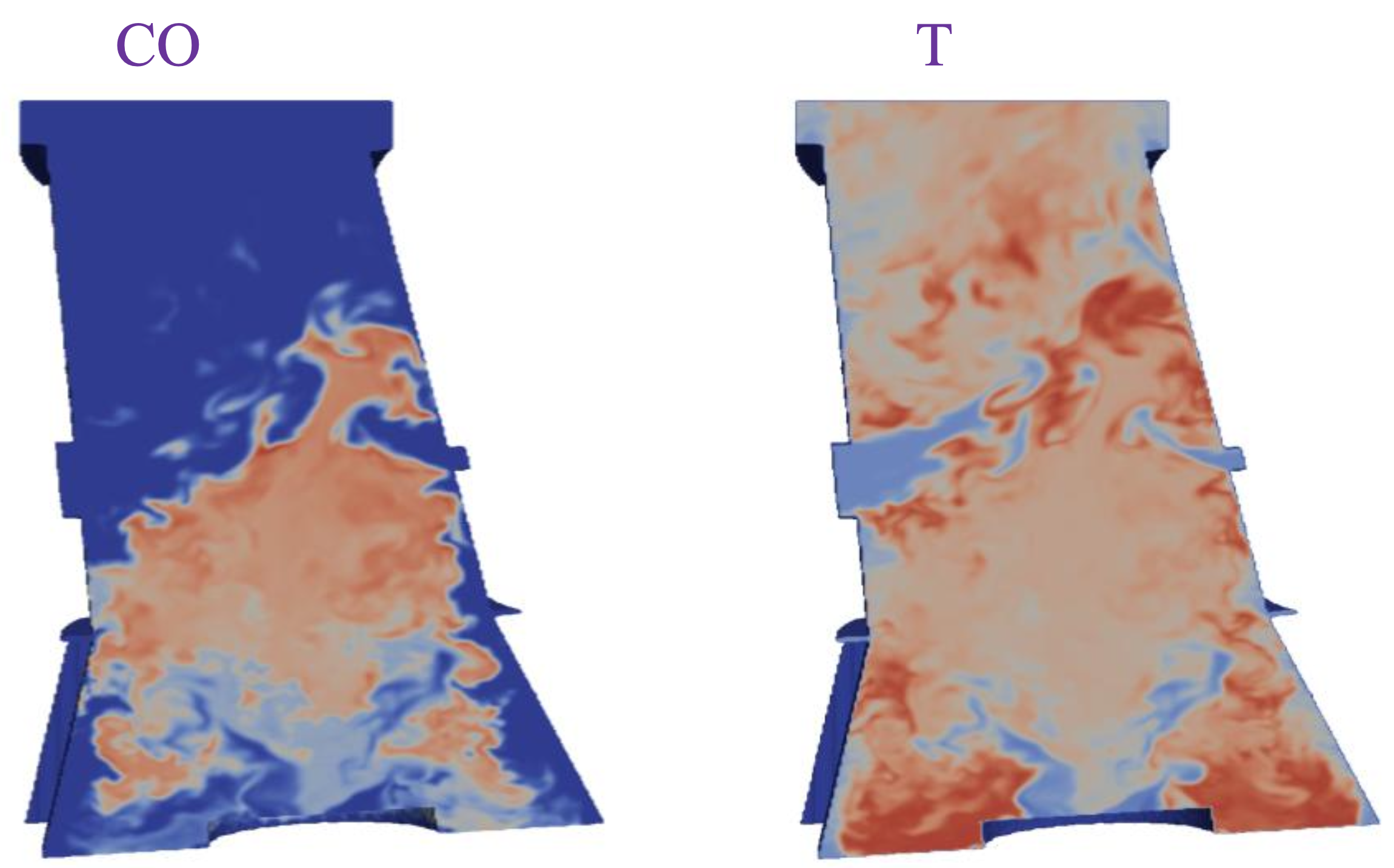
Gas turbine simulation in Airbus A320neo combustor 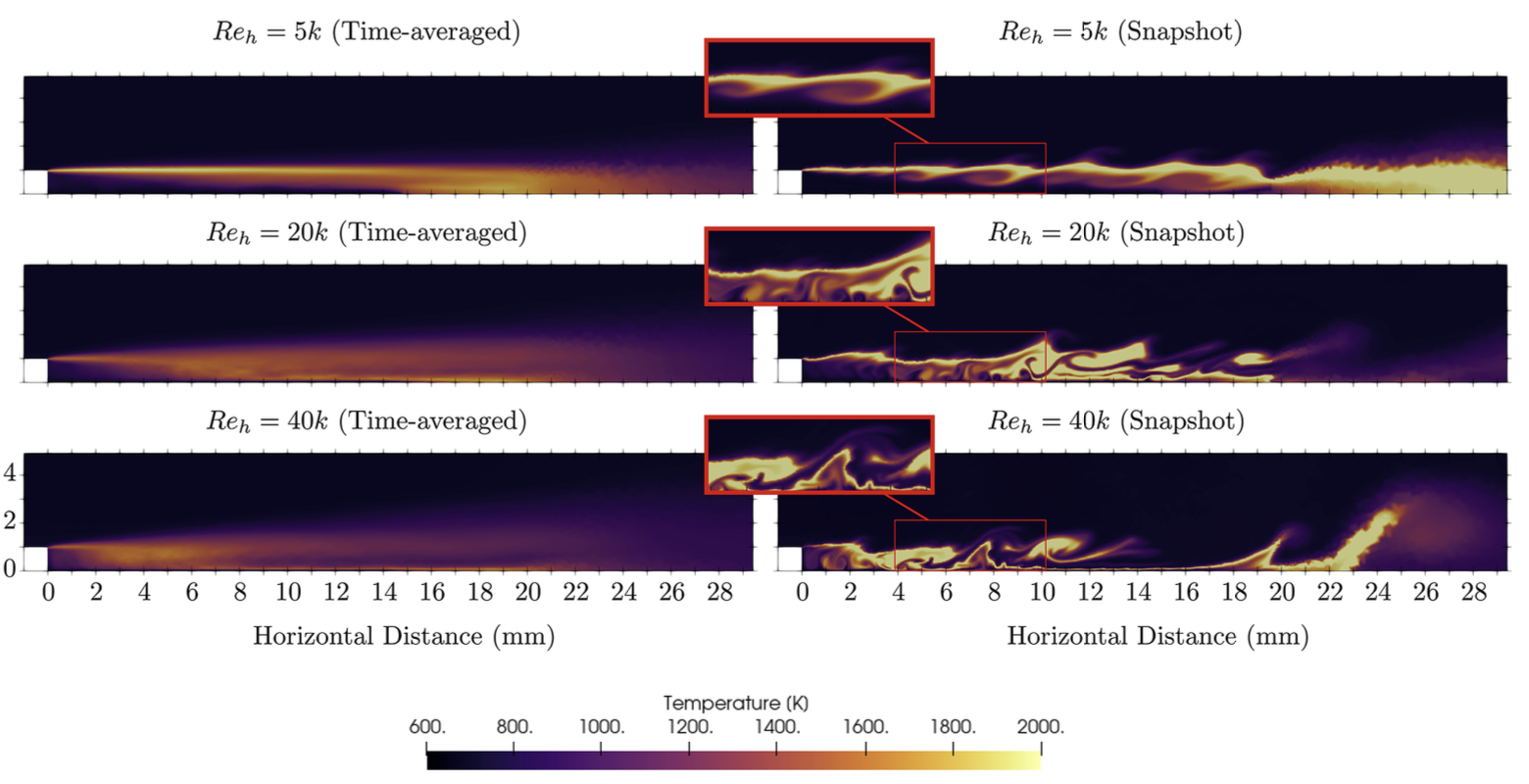
2-D backstep combustion process
-
GPU-Accelerated Reacting-Flow Simulation
Contributed to a CUDA-accelerated DG Navier–Stokes solver for compressible, reacting CFD; contributed boundary conditions and reduced-order models (ROMs).
-
Reduced-Order Reacting-Flow Models
Developed 1-D multiphase detonation ROMs achieving 106x speedup vs direct numerical simulation while matching key physical trends.
Selected Publications
- Tricard, N., Chen, Z., Deng, S., 3-D representations for hyperspectral flame tomography, arXiv preprint arXiv:2603.27832 (2026). link
- Wang, L., Chen, J., Tricard, N., Chen, Z., Deng, S., GLU: Global-local-uncertainty fusion for scalable spatiotemporal reconstruction and forecasting, arXiv preprint arXiv:2603.26023 (2026). link
- Tricard, N., Bojko, B., Inlet conditions and fuel effects on structures in backward-facing step combustor, Journal of Propulsion and Power, in press (2025). link
- Chen, Z., Tricard, N., Deng, S., Hybrid physics-ML for multispecies and temperature inference from FTIR spectra, Proceedings of the Combustion Institute, 2025. link
- Wang, L., Tricard, N., Chen, Z., Deng, S., Computational methods for CNT growth modeling, Nanoscale, 17 (2025), 11812. link
- Tricard, N., Fraga, G., Zhao, X., Optimal parameters of Monte Carlo ray tracing solver with line-by-line spectral database, Proceedings of the Combustion Institute, 2024. link
- Tricard, N., Kim, S., Deng, S., Inferring complex chemistry in thermal waves, to be submitted to PNAS.
Contact
For research collaborations, internship opportunities, or questions about my work, feel free to reach out:
Email: ntricard@mit.edu
GitHub: github.com/nick-jt
LinkedIn: linkedin.com/in/nick-tricard